

“I am convinced we have a degree of delight, and that no small one, in the real misfortunes and pains of others…”
Edmund Burke, 1757
Years ago, following the infamous 2017 Equifax cyber breach, viral outrage was sung in unison chorus. From afar, mature firms behaved as immature:
“Equifax deserved their comeuppance. The security team, the executives, many of them had no clue. And they froze in delayed disclosure. For months...”
The mean-spirited chuckles even included the ridiculous, shortcut laziness, taunting the much-maligned executive staff, laughing about their college degrees. The chief information security exec’s journey in cyber (post college) and her quite formidable risk management successes before the breach were kicked aside, ignored, trashed with torch and pitchfork blame. The crowds charged the true trigger -- the person’s college major.
Aha, that was it! The smoking gun was her two music degrees!
As if this was causation.
Within my own circles at the time, a senior cyber manager stated a more tempered view. “There but for fortune go I.” And it was an accurate view.
Not because his performance was ever suspect, nor was the team undisciplined. I was privileged to lead him and the stellar group -- stellar long before I got there. The observant pro, a wise risk mitigator with a critically holistic and empathetic mind, understood that human beings (and their offspring of complex processes) can never reach perfection.
Corporate penalties are settled law, and for good reason. Executives steer the firm and set the culture. But it’s distasteful if any firm’s culture behaves with taunts or accusations of malfeasance against a competitor, when reality is more complicated, and oversights unintentional.
Without digging up any more bones, a lot went wrong in both deed and response for the credit agency. And the outcome was material pain, stress and consternation for thousands of customers. The hammer fell for several execs as expected. Even if you’ve had an admirable, storied tenure, your last “at bat” is what’s remembered. Nevertheless, over time, and despite enormous fines and episodic failure, the company bounced back.
But it was not an underdog’s recovery.
Firms a fraction of Equifax’s size would have been dust in the wind. But the institution was and is a card-carrying member of the credit oligopoly; cost of entry and other hurdles fence off many competitors.
So, in the end Hester Prynne’s scarlet letter was hung upon a few necks, but by and large things went along. Hawthorne’s protagonist reminds us of the callousness and unfettered blame, often directed at a singular person. One who becomes unfairly stamped as the face of failure, when it’s sometimes bad luck.
Not always, but often enough, and with extreme prejudice.
* * * * *
There’s something about pitfalls and stumbles, foibles and crumbles where fault is shouldered by the sacrificial goat, where context is cruelly ignored, and schadenfreude finds nourishment.
We become lazy, judgmental, comfortable in our finger pointing, especially when life is viewed as hierarchies of power. The chief is rarely guiltless, the functionary rarely culpable. That assignment might be correct.
Or it might not.
Causation is messy, culpability is foggy, when many factors tumble like dominoes toward disaster. Unseen ploughs have upended the best laid schemes o’ mice an’ men, when those tools were not intended for malice.
In the 2025 novel Culpability by Bruce Holsinger, we watch micro faults that culminate in human catastrophe, all while the story’s AI machine did what it was supposed to do: try to avoid disaster.
While the story overplayed its contrivance of characters and coincidence, it skillfully underscored the dilemma with aplomb. The author spreads the errors across the field, suggesting that outcomes are formed by many hands. The intrigue envelops an entire family.
In some ways we wonder if culpability can apply to everyone, which implies no one. Further, accountability is often skirted when the helping hand of socio-economic success is in one’s back pocket. Holsinger’s thoughtful narrative presents complexities that are hard to solve, when a figurative smoking gun shows fingerprints of many. It’s a story that we shall face again, when (not if) AI has a hiccough, sorting it all out with litigation scenes of developers and attorneys, consumers and detectives. And hopefully no fatalities.
The interesting novel also did something else. It seemingly, deliberately, leaves some readers unfulfilled.
Watchers and readers of artistic narrative always want to get the bad guy, any bad guy.
Solve it.
Codify it.
Assign the blame, and assign the shame.
Even when the puzzle is too complicated for the mystery.
We’ve been here before.
* * * * *
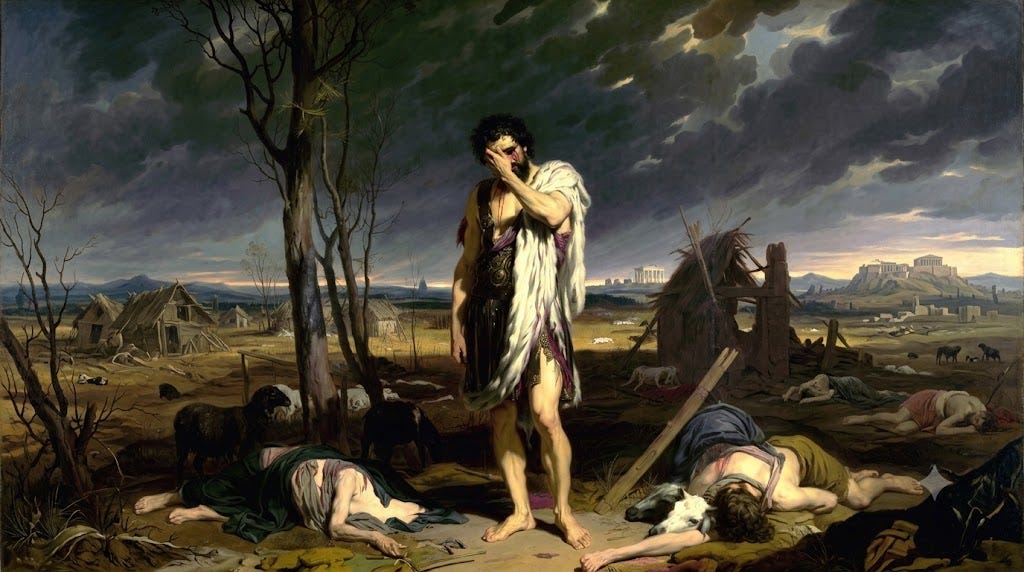
In dramatic environs we time-travel 2,500 years backward, as playwright Sophocles scribes Oedipus Rex. We hear that an entire populace suffered under the accidental behavior of the king. The gods ravaged a society, damning the city state with plague’s devastation, the punishing consequence of the leader’s sins -- patricide, incest, self-mutilation on the march toward exile. Dramatists of ancient Hellas never pulled their horrifying punches when crafting their explicit morales. Greek belief held that extreme offense and familial immorality were enough to lay blame on all subjects: “You served the leader, and now you’ll suffer because of it.”
While we obligingly give lip service to civilian protection in war, we ignore the reality. Not much has changed, as collateral damage is often a “not-me” headshake, rationalized under survival extinct. Assigning blame to the leader was often the “satisfactory” perspective, whitewashing war’s immorality. The Greek citizens of Thebes suffered the punishment of the gods because they lived in the wrong town.
They saluted the wrong royalty.
The plague was divine retribution, sickness, crop failure, infertility, death blanketing all who were just going about their day-to-day business. If you think employees were unfairly tarred under a corporate process failure, imagine having been a farmer in Thebes.
Sometimes catastrophic chains of events are undeniable and indefensible. Without empathetic analysis, they conspire to destroy all, through some perverted alignment of angry stars and demons.
* * * * *
In our present day, most levels of automation are constructed without malice, or ought to be, promoting mitigation of human error, constancy in vigilance, confidence that the company assets are protected and that externalities are limited. Yet we forget too often.
No matter how advanced our AI becomes, or how streamlined our technology evolves, company employees, coached by managers, and directed by executives, must always be the god of the machine.
In 1912, the White Star Line’s Titanic exemplified such a fate. The hubris of “unsinkable” was a safe money bet. Four forward compartments could be flooded, and the ship would remain afloat. But outdated regulations (rather than common sense) held that the ocean liner was not at risk, even without enough lifeboats for every soul on board.
Distress signals were interrupted due to customer service transmissions.
While the night was crystal clear, an iceberg could have been more visible. But conversely, under still waters, the berg would be disguised with no breaking of waves signaling the submerged devilry.
These are just a few instigators among a laundry list of dominoes that had to fall that dreadful night.
The safe bet was broken. Many links in the process chain were unlikely to break simultaneously.
But in a contagion of faults, they did.
In motion pictures, plays and dramas, the White Star Line’s Managing Director, Bruce Ismay, is often played as a cowardly and nefarious creature, uncaring of the human toil, only concerned with the business impact. Yet the reality was far more complex. Ultimately, he lived out his life in self-imposed, shame of seclusion, vilified as the omen carrier, the villainous god that destroyed an ocean liner.
“Heh, got what he deserved, ‘e did.”
Another domino that fell.
Scapegoats make life’s explanations and worry less uncomfortable. Unraveling the threads, attempting to detangle the spools of risk is disconcerting work. But if one target can be identified, the explanation is a neat fit; no need to go deeper. The bad guy is caught. But for those building ships or creating minds in machines, depth is a mandate, an expectation on which humanity depends.
* * * * *
And then there is the blame assigned to those who have nary a fingernail in the outcome -- collateral damage of an innocent spectator. The wrong place at the wrong time. Or in the field of play when sadistic gods upend normalcy.
In 2003, Chicago Cubs fan Steve Bartman faced the wrath of frenzied crowds, fans who were embarrassingly as superstitious as Sophocles’ audiences thousands of years prior.
Perennial wannabes pursuing a National League championship, the Cubs team seemed ripe for the playoff victory and a gate into the World Series. In the eighth inning of Game 6, the Florida Marlins were down to their last five outs, when fan-in-the-stands Bartman reached for a ball barely headed for the seats. He was not alone in grabbing at the flying souvenir, as surrounding arms attempted to grab as well. The Cubs outfielder leaped high, attempting a circus catch. But the ball hit Steve’s hand. A close judgement by the umpire, the ball was ruled a foul, no interference.
Angry roars of the home team masses were like rabid grizzlies. Bartman sat quietly, the victim of rough and unruly fans verbally assaulting him.
Strangely, on the field, a complete meltdown followed the play; it was a team meltdown. Run after run crossed home plate as Marlins batters attacked like a diabolical parade. The Cubs’ defense was suddenly afflicted with utter dysfunction -- errant throws, wild pitches, overall hideous play. The hometown fans watched inexplicably as their team torturously blew their lead. In the blink of an eye they gave up eight runs – more than most teams give up in an entire game.
With cameras at every angle, the foul ball episode was incessantly replayed like a bad Reel on Instagram. Bartman was the media’s face for the game.
Bearing some kind of zombie affliction, the multi-thousand-person mob was salivating for atonement. They booed and blamed a singular person for the team’s jaw-dropping implosion — a person that had nothing to do with the Cubs’ ignominious failure.
Did the fans somehow think the non-interference call had the cosmic power to turn the home team into Odysseus’ sailors, transformed into fumbling beasts by the ancient witch Circe?
For many days after the game, Bartman faced anonymous death threats from unthinking brutes. The unassuming, long-time fan was thrown into a pit of public hell.
Twenty plus years later, one cannot admire Steve Bartman enough. He maintained and, by all accounts, maintains his privacy and his sensibility. This ordinary man with extraordinary, quiet strength and courage, moved forward to live a normal, noble life under a bizarre, unwanted cloud of ridiculous exposure. He was a man of steel in a world of visceral antagonism.
* * * * *
We are living in this early age of AI under a conflagration of outlooks, reactionary, strange polarizations. Simultaneously we are entrusted to be watchful eyes over machines, assuring each other that those artificial minds do not rise up like angry mobs or sadistic, mythological directors of fate. Our currently absent serenity is the necessary antidote.
We are expected to see machines as machines, to see human beings as flesh and blood neighbors who simply seek stability and peace in their everyday dealings.
Our epistemic humility is our soul-defining value -- the strength to resist simple, sometimes senseless explanations for complex phenomena and bad luck. Accountability is still required in our lives, demanding atonement for error is not hateful in and of itself. But barring malice and pure evil, I will always remember that security engineer: “There but for fortune go I.”
Momentous responsibility weighs upon us, as we inject autonomous AI into new domains and influence humanity’s journeys. However distant our individual links in the chain, or however many other links are safety valves, we each have our own individual fingers on what’s to come tomorrow.
The ancient gods may cast cynical eyes upon our hubris, if they again glimpse the arrogant signals of schadenfreude toward others’ mistakes.
. . .
Thanks for reading Humanities in Management.
Please pass along to those interested.
I couldn’t sleep, John, so read this slowly at 4.30 this morning. And again just now. There’s so much in there to unpack and think about, I’m so glad I read it early before the day swallows me up. Thank you.