

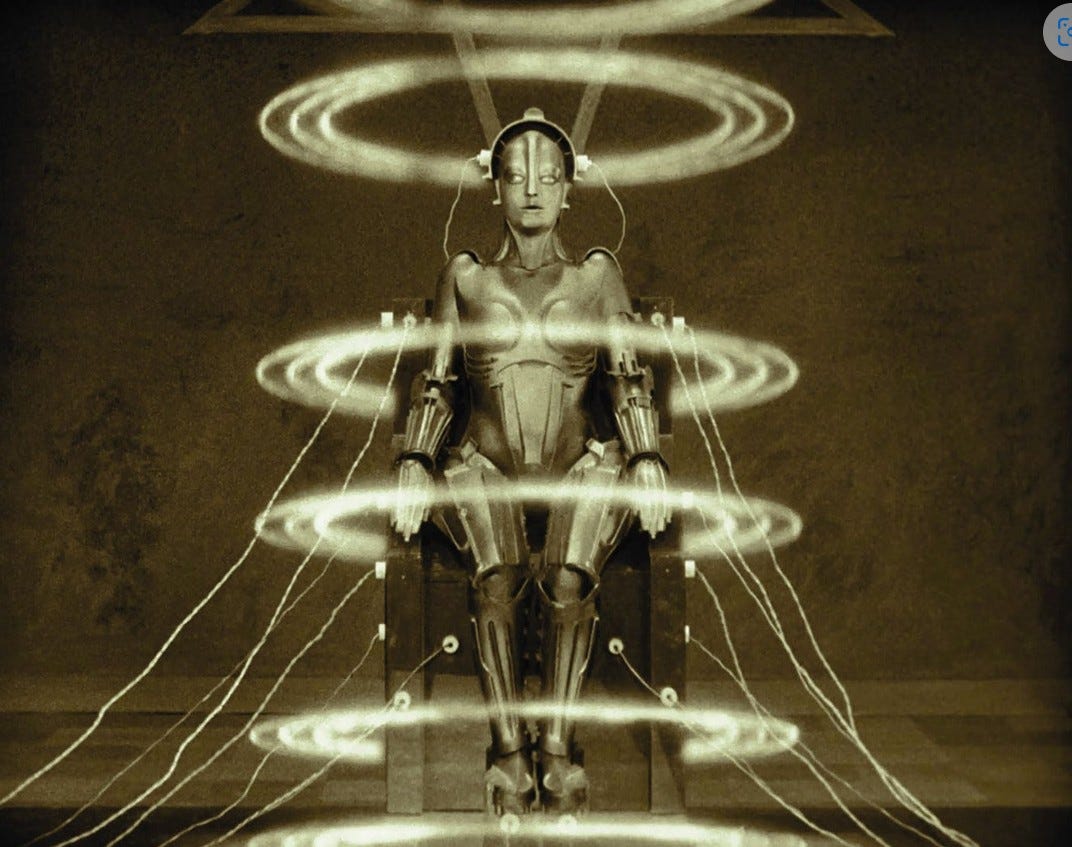
“Who is the living food for the machines…- ? Who lubricates the machine joints with their own blood - ? Who feeds the machines with their own flesh - ? Let the machines starve, you fools - ! Let them die - ! Kill them - the machines - !” (Metropolis, 1927)
The climactic resolution of that cinematic tour de force didn’t resolve the dichotomy of worker vs. thinker paradigm. It proposed a mediation or empathetic détente between the contrasted social classes. The zeitgeist was understandable at that moment in history. But it should be less so now, while a “worker vs. thinker” perspective is offensive on its face.
Yet vestiges of the class perspective remain, instead of the person perspective. An executive who views the firm as such has forgotten that the company’s future depends on individuals, each of whom must innovate and grow, lest the firm wither and die.
Metropolis machines were sustained by bodies whose only value was rote care and feeding of the infrastructure and technology. The irony we recognize today (or we had better) is that care and feeding machines, adaptation of automation to processes, and the technological miracle that is quality of life, stem from a true collaboration among all management, every professional, and machine.
From exotica-driving execs to cart-pushing caterers.
Professionals by definition.
Supporters of the firm’s raison d’etre.
Machines won’t execute more nobly unless those who build and nurture them understand the day-in-the-life of our planet’s fellow travelers. The builders and nurturers are omnipresent. Their behaviors are manifest in humanity’s cycles. They are you. And everyone else.
Observational and experiential moments are culminated and encapsulated by data strings of history. Sadly, coffee-table books chronicle civilization’s walkways as who-killed-whom timelines, tales of good and evil represented in glorified narcissists or, conversely, execrated devils. And the beat goes on.
The true goodness in our mornings is comprised of pursuits, from riveting to reading, abilities of the knowledge professionals, masters of adaptation, and pillars of innovation. Knowledge professionals are mistakenly equated to so-called thought leaders, Rodin’s offspring, seated in technology spaces and boardrooms. Knowledge professionals are, rather, every individual in the firm.
The lifeblood of the company, man and machine, is the contribution of each, the customers’ benefactor. The teams are the forces of dynamic adaptation, adjusting to latest tools, processes, trends. It is incumbent on enterprise management to cultivate the mindset of flexible adaptation and knowledge, just as it is incumbent on all professionals to ensure their own value in the changing world of machines. And respect the participation of infinitely different personas.
We already know all this, I hear repeatedly.
Then why don’t we behave accordingly?
In an engagement a decade ago, I recall a divisional executive who was commenting on a senior manager (not present at the time). Well, he wasn’t commenting, but instead criticizing openly to others in the room. The executive characterized the manager as a “sycophant.” Startled by this condescension, I thought long and hard about it. I had watched that senior manager regularly, learned from him, coached him. He always struck me as open, transparent and hardworking. The manager was not a sycophant but simply polite to every human being in the building, extraordinarily respectful to the custodial staff, the cafeteria staff, every supervisor, executive and professional alike. He was more than the quintessential “nice guy”; he was openly decent and considerate.
He never shied away from challenging his supervisors; I saw him go head-to-head in a nearly heated exchange, which was also one of the most compelling and profound debates on strategy I had ever witnessed. So why would that executive characterize him as a sycophant?
I then considered the executive who bad-mouthed him -- a surly, sarcastic and arrogant soul. The final adjective gave me the insight. The executive just assumed that the manager was nice to him only because the executive was one of the “bosses.” It never occurred to the executive that the manager’s nature was optimistic and polite because that is who he was. The sincere kindness in every exchange was not just toward executives, but to everyone in the building.
Every professional, which means every single employee, partner, contractor, laborer works with the enterprise and other employees. They do not work for them.
That executive represented everything that is wrong with an organizational hierarchy. He never understood that each role in the connecting tissue was less about “boss and subordinate” and more about accountability and responsibility:
The manager mobilized an engineering team.
The executive reconciled priorities against external business factors.
The manager did a job.
The executive forgot his.
He, himself, was also another employee working with the firm, whose responsibility was to optimize performance for its customers. He instead paraded the power imbalance and behaved as reactionary decision maker, not a deliberate strategist.
Each function reporting along the chain would crush the overall success of the division if its teams were not effective, not seeing their own hands in the firm’s reach. But the executive had no empathy, no ability to comprehend other personalities, differentiate among contributions. He only sustained his outlook via his brusque ego, seeing kindness and courteousness as weakness.
. . .
Quality of life is rising. With distressing concern.
Empowerment of individuals is growing thanks to machines, our robot allies. Those robot partners help us deliver the innovation, in mass production, speed of analysis and ironically in risk mitigation. Disruptive innovation demands knowledge professionals who are advancing their own careers in line with the advancing capabilities of the firm and growing automation. These knowledge professionals are mythology’s Argus, the giant guardian of a hundred eyes, now provoking mutual discovery and analysis in every action across ecosystem.
Jobs are not static; they are transient and ever changing. The noun is also a contentious concept. It’s unsettling to accept that nobody owns a job. Jobs are human executables during a day-in-the-life. They are not owned any more than one owns a career or task, a relationship, a morning jog, a written keystroke. (Now if you want to argue that machines are slaves, I’d defer the philosophical challenge to when robots become sentient and emotionally self-aware.)
We travel through our individual timelines by trading for mutual benefit. The acceleration of contributions is correlated with diminishment of marginal cost. And the institutional dilemmas are amoral.
The near-term outcome: human pain of displacement.
Arguing against this changing tide is unavailing. But arguing about ways to mitigate human impact is not. Displacement cannot be ameliorated without innovating toward new human action, new pursuits, and portals of change.
When managers and team contributors both recognize that they are mutually dependent, and are responding to change as well as driving change, they are both enabling an innovative company and future. And enhancing mutual respect. It’s a call to action.
Forward-looking HR plays the vital role here. Treat displacement as a strategic challenge, partnering with leaders on innovation opportunities. Eschew transactional offboarding checklists. Embrace the intersection of corporate strategy with workforce dynamics and needs. View the operating model as roadmap, with deep thinking adjustments on the horizon. Leverage the human factors that are seated right in front of you.
As we face the “great change,” both manager and individual contributors are accountable for adapting the robots around us, building better robots, adapting to seas of enterprise metamorphosis, and realizing new ways of adding value beyond rote activity. Noblest of firms see not busy work to sustain, but as engagement and discovery of new avenues of worth, inside human skin.
Executives are accountable to recognize, to notice, every professional in the company. They are the lifeblood of our machines who are the lifeblood of convenience. The conceptualizers, imaginers, and futurists are also accountable for whistleblowing: errant machine behavior, and opportunities to counter displacement.
Fritz Lang’s pioneering film, extraordinarily produced a century ago, was prescience. We recognize again, we have been here before, as the robot ‘Maria’ reminded us:
“There can be no understanding between the hands and the brain unless the heart acts as mediator.”
All of us are Argus now, watchful innovators, great empathizers.
An executive without empathy and an individual contributor without empathy are dysfunctions on the horizon, like malware in an unsuspecting machine, hallucinations accepted by rote acceptors, failing to see their own significant accountability.
The professional, the executive, and the enterprise have something else in common. At the heart, if none of them innovate, none of them will survive.